StationPlaylist Studio is Windows radio automation and live assist software. It includes a built-in stream encoder called SPL Encoder, and there is also a separate encoder program called Streamer. Both can stream to Icecast servers. This guide covers installing Studio, adding an encoder with the Icecast2 type and going live.
Before you start. Before you start. StationPlaylist is Windows software. Each trial download is a full 30-day trial, but the trial of Studio stops after 6 hours of continuous use, and you can restart it. Studio plays from your computer, so keep it on and connected while you broadcast. Check stationplaylist.com for current prices.
Windows radio automation and live assist software. Studio includes a stream encoder, and Streamer is a standalone encoder.
Where to find your connection details
Every program on this page needs the same five details to reach your station: a server address, a port, a username, a password and a mount point. You copy them from your control panel. It takes about a minute, and you only need to do it once for each program.
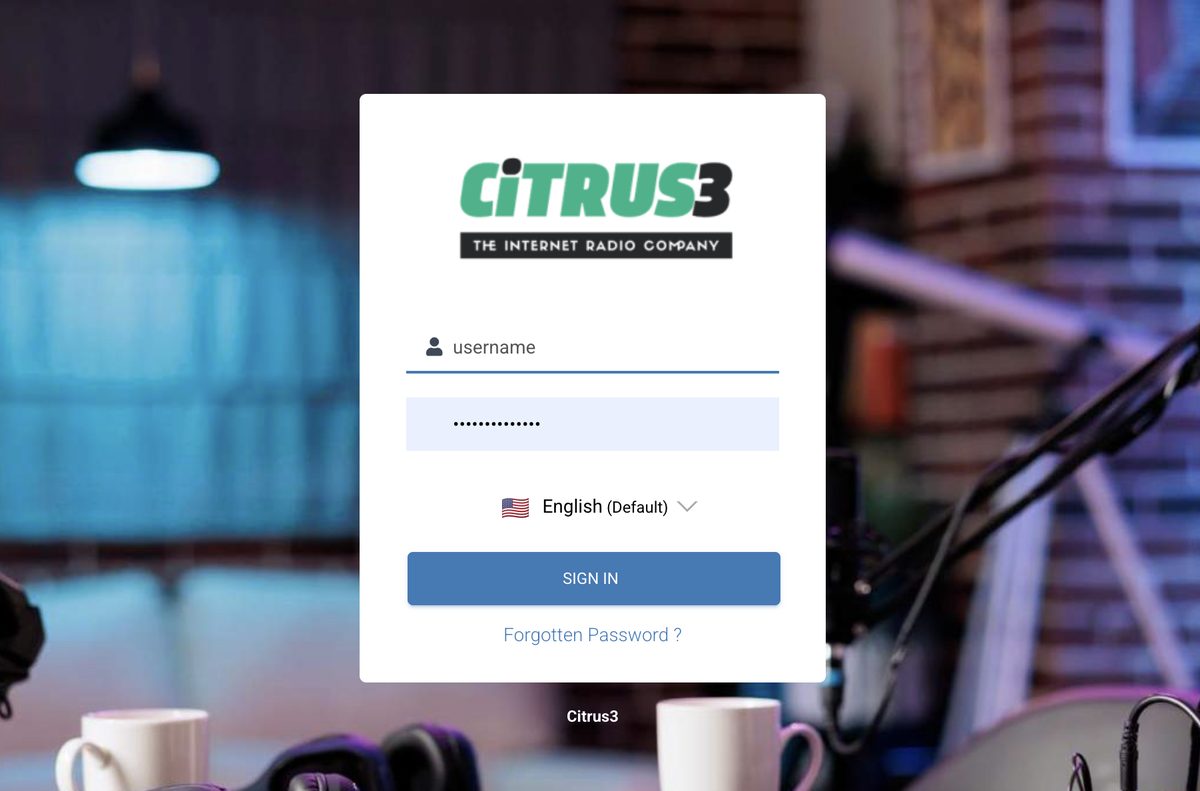
1. Log in to your control panel
Use the control panel link and the username and password from your welcome email.
2. Go to the dashboard and click How to connect
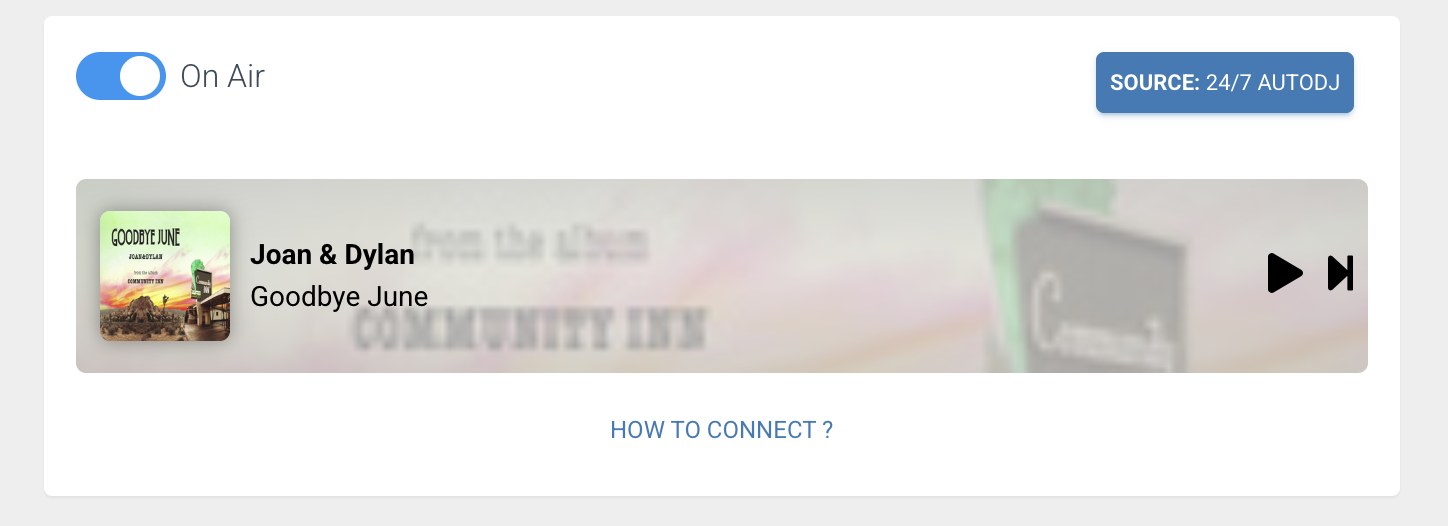
After you sign in you arrive at the main dashboard. Next to the preview player you will see a blue link called How to connect. Click it.
3. Copy your five details
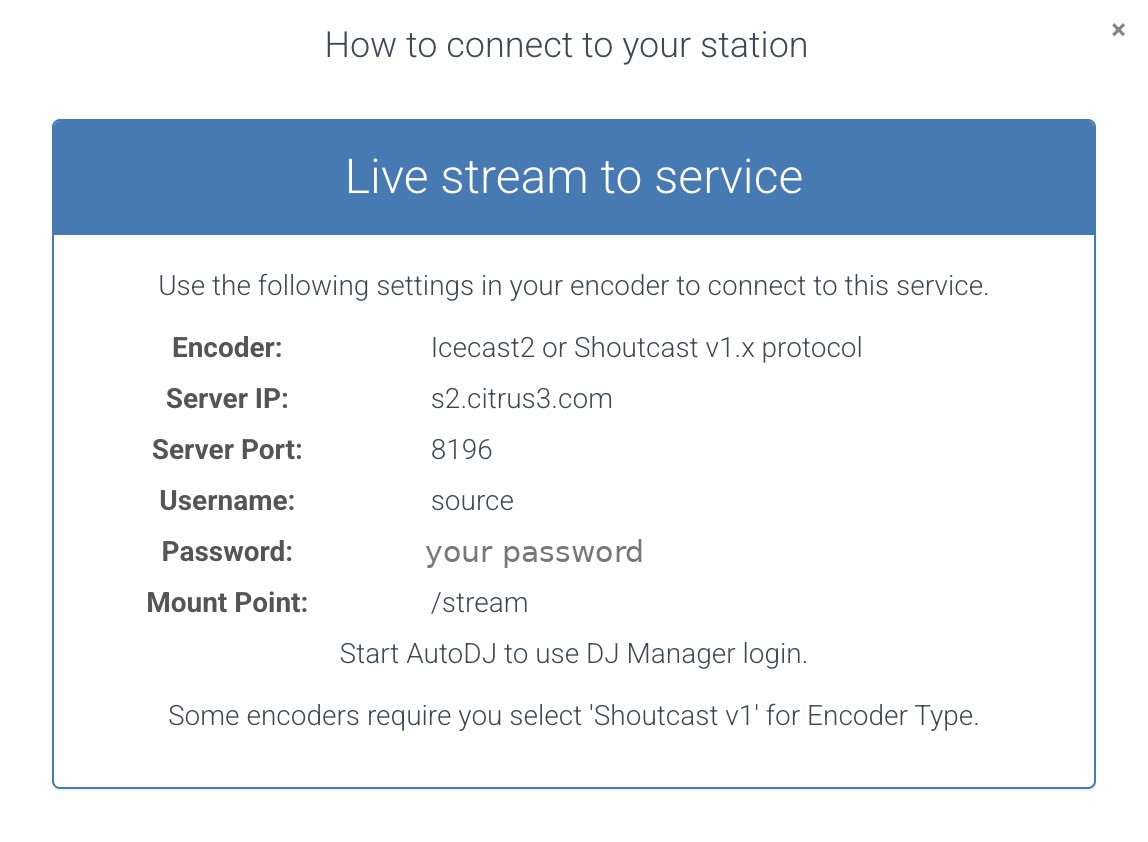
A window opens with your connection details. Keep it open while you set up your software.
| The window shows | What it is, and what your software may call it |
|---|---|
| Server IP | Where your station lives. In your software this may be called Address, Host, Hostname, Server or Server URL. Enter the address only, with no http://. |
| Server Port | The port number. Your software calls it Port. |
| Username | Called Username, User, Login or Encoder username. It is often source, but use the one shown on your dashboard. |
| Password | Your source password for broadcasting. Your software may call it Password or Encoder password. It is not the password you use to log in to the control panel. |
| Mount Point | The stream path. Your software may call it Mount, Mountpoint or Stream path. Copy it exactly, including the slash at the start, for example /stream. |
- The window says Icecast2 or Shoutcast v1.x. Always choose Icecast (or Icecast 2) as the type in your software.
- It also says Start AutoDJ to use DJ Manager login. That only matters if you use separate DJ accounts. Your station’s AutoDJ must be running for those logins to work.
- Copy and paste each value instead of typing it, and keep your password private.
- When you connect, your live broadcast interrupts your AutoDJ programming. When you disconnect, the AutoDJ resumes by itself.
Steps
- Go to stationplaylist.com, open the download page and download Studio. If you only want an encoder for another program, download Streamer instead. Run the installer and follow the wizard.
- Open Studio and add your music, playlists and any jingles you want to play.
- Log in to your control panel. On the dashboard, click the How to connect link next to the preview player and keep that page open. You will copy five details from it: the server IP, port, username, password and mount point. The pictures at the top of this page show where to look.
- In Studio, go to the Output options and, on the Mixer tab, enable SPL Encoder. This is Studio’s built-in encoder. If you use Streamer, it has its own encoder window.
- Open the encoders window and add a new encoder. Double-click it to open its settings.
- Set the Samplerate to 44100.
- Set the Server Type to Icecast2. Do not choose a Shoutcast type.
- Enter your server IP in Server IP and your Port in Server Port.
- Enter the username from How to connect in Encoder Username. Many Icecast servers use
source, but use the username shown in How to connect. - Enter your source password in Encoder Password.
- Enter your Mountpoint exactly as shown in How to connect, including the leading slash.
- Choose the audio format and a bitrate within your plan, such as MP3 at 128 kbps. Studio’s encoder supports MP3, AAC+ and Ogg Vorbis.
- Click OK to save.
- Click Connect in the main window. Clicking the same button again disconnects. Your live broadcast now interrupts your AutoDJ.
- To finish, click Disconnect. Your AutoDJ resumes automatically.
Settings at a glance
| Setting | What to enter |
|---|---|
| Samplerate | 44100 |
| Server Type | Icecast2 |
| Server IP / Server Port | Your server IP and port from How to connect |
| Encoder Username | The username shown in How to connect |
| Encoder Password | Your source password |
| Mountpoint | Your mount point, starting with a slash |
| Format / bitrate | MP3, up to your plan’s bitrate: 128 kbps on Starter, 256 kbps on Large and Pro, 320 kbps on Enterprise |
Studio or Streamer?
Studio plays your music and runs the show, and includes the encoder. Streamer is a standalone encoder with no playlist or player: it takes sound from a line-in or from the local network and sends it to your station, and it can read track titles from a text file or from Studio. Choose Streamer only if you play your music in another program. On Windows 10, you may need to allow microphone access in Windows privacy settings before Streamer can record from the Line-In.
Check that it is working
Open your radio page, or press play on the preview player on your dashboard, and listen. Expect a delay of a few seconds between what you do and what you hear, because every internet stream has some. For the most honest test, listen on a phone over mobile data. If you can hear your show, you are live, and your AutoDJ is paused until you disconnect.
Troubleshooting
- The encoder is not in the list. Enable SPL Encoder on the Mixer tab of the Output options in Studio.
- The trial stopped after a few hours. The trial editions stop after 6 hours of continuous use. Restart the program to continue testing.
- It will not connect. Open How to connect again and compare every field character by character, or copy and paste each one. The server must be entered as an address or IP only, with no
http://, and a mount point must begin with a slash. - It says the password is wrong. Use the source password shown in How to connect, not your control panel login password.
- It connects but listeners hear nothing. The program is sending silence. Check that the right input is selected, that the level meters move, and that nothing is muted.
- The audio stutters or drops. Your upload connection is the usual cause. Close video calls, cloud backups and other uploads, use a cable instead of Wi-Fi, and try a lower bitrate.
- The audio sounds too fast, slow or distorted. Make the sample rate the same everywhere (44100 Hz is the safe choice) and keep your levels out of the red.
- My AutoDJ did not come back. Make sure the program has fully disconnected, then wait a short while. If the station is still silent, email support@citrus3.zendesk.com.
- Use Icecast2 as the server type.
- The password field is your source password, not your control panel password.
- Keep your connection details private.
When you disconnect, your AutoDJ continues the programme.
Need a hand?
We typically reply within a few hours on weekdays (9:00 AM to 5:00 PM UK time).
Contact usNext guide: Broadcast live with NextKast